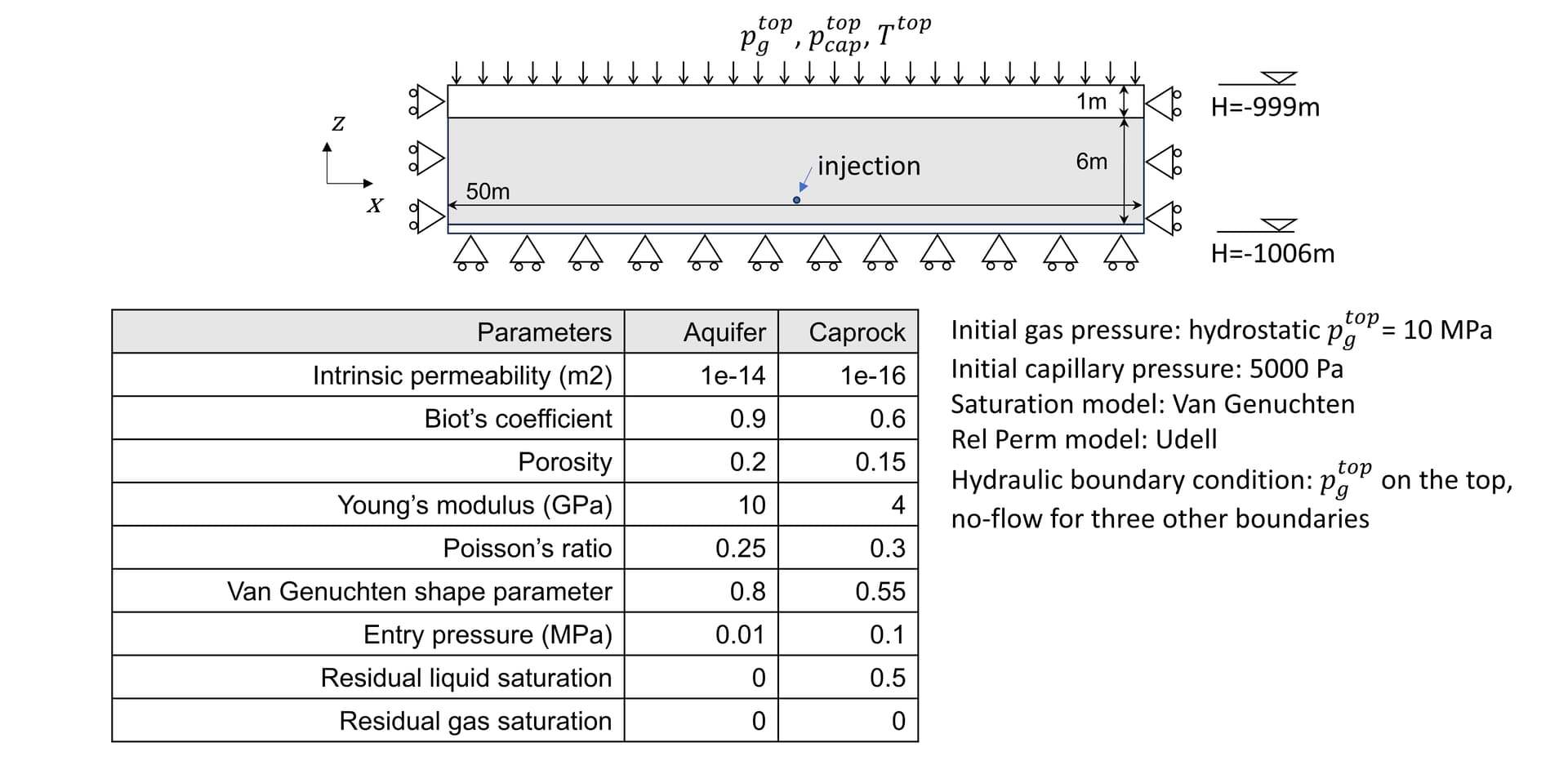
Hi all, I have been simulating CO2 flow in a model with two layers, i.e., capock and aquifer, trying to model the CO2 invasion into the caprock. The size of the model is 50 x 7 m. The thickness of caprock is 1m and the thickness of aquifer is 6 m. The injection is located in the center of aquifer which is a line source term. The injection rate is 0.003 kg * m2 / s. The saturation model of the caprock and aquifer is Van Genuchten model and relative permeability model is Udell model which have been implemented in OGS6. The initial gas pressure on the top boundary is 10 MPa and distribution in the domain is hydrostatic. The initial capillary pressure is 5000 Pa and the distribution in the domain is constant. Top boundaries are Dirichlet for both gas pressure and capillary pressure. Other three boundaries are no-flow. I only consider hydraulic process so that the displacment and temeprature are fixed not to change during the simulation. The parameters properties in aquifer and caporck are listed in the following figure.
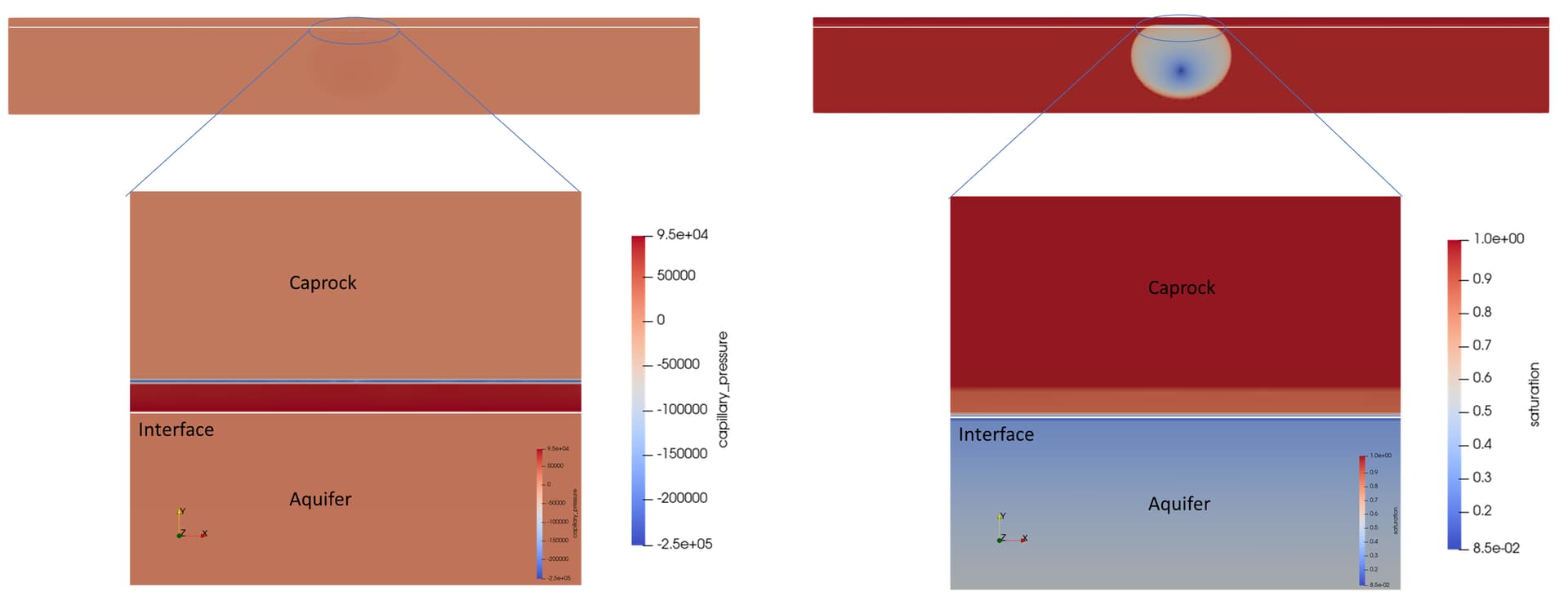
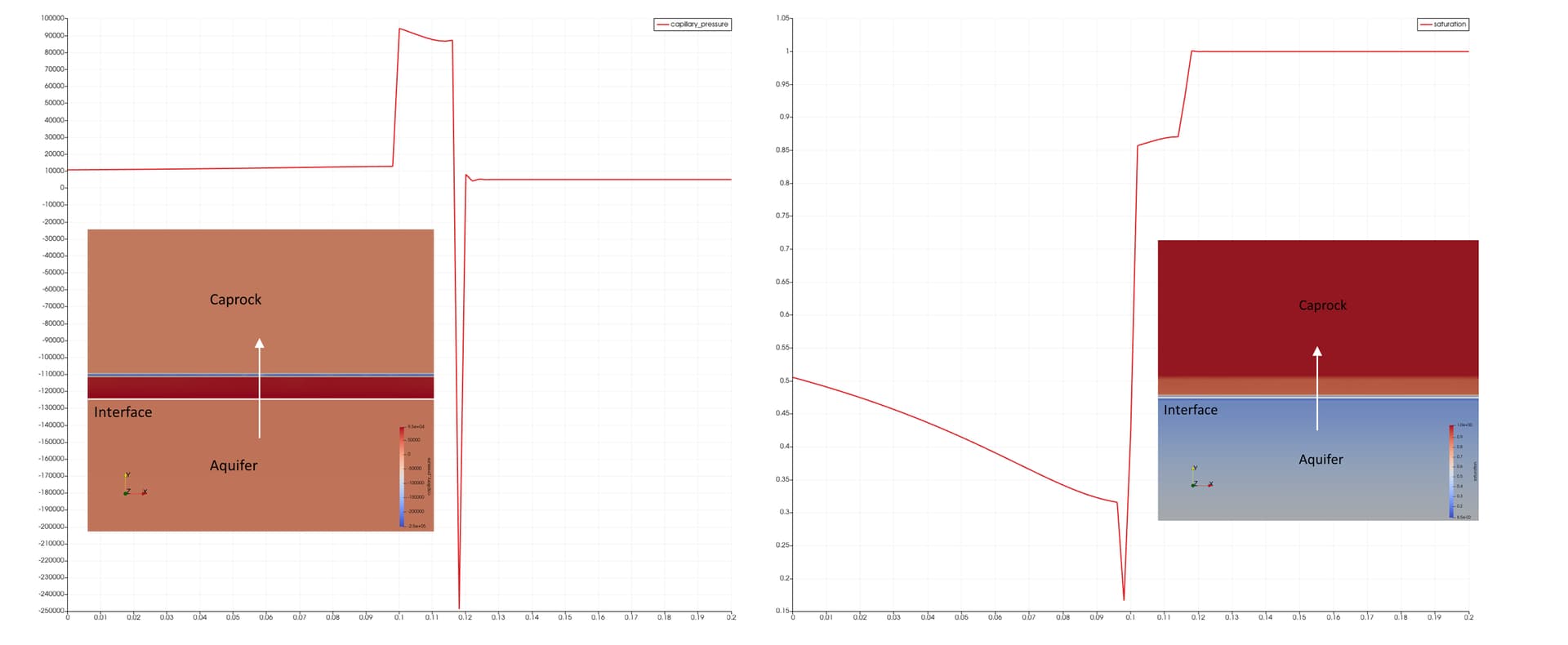
After the equilibrium the injection of CO2 is 14 days. In the figures below the injected CO2 has floated up due to the gravity and invaded into the caprock. A high capillary is seen around the interface. However, in the caprock the saturation front meets a very large negative capillary pressure, but the saturation looks smooth in the caprock. I think the high capillary pressure in the caprock is good to see because the entry pressure is higher. However, The negative capillary pressure on the front looks strange. A slight oscillation is normal but such a large value (-2e5 Pa) is problematic to me. Decreasing the entry pressure of the caprock to the same value as that in the aquifer could help but I think this is not realistic. The capillary pressure and sarturation curves across the interface have also been uploaded. In the curves, the large negative capillary pressure exists where the saturation has just a little bit oscillation (around x = 0.12 m in the curves).
For the current results, I wonder if there are some numerical stabilization terms in OGS which can help this oscillation? Or there are some other problematic parameters in my model with these aquifer and caprock layers?
Thank you very much for the time.
Best,
Yuhao